Most CRM advice assumes you're closing software deals with three decision-makers and a six-week sales cycle. If you run a food truck or a small restaurant, that's not your world. A CRM for food trucks and small restaurants has one real job: stop the money you already have in hand — catering inquiries, event bookings, and repeat customers — from quietly slipping away in a pile of DMs, texts, and voicemails.
The service across the counter runs fine. The part that leaks is everything that happens before and after the meal: the wedding inquiry you meant to reply to, the office that books you every quarter but you forgot to nudge, the brewery that wants you back but you lost their number. That's the part a lightweight CRM fixes.
Where food and restaurant revenue actually leaks
Walk-up and counter sales take care of themselves. The revenue that depends on memory and follow-up is where a small operation bleeds:
- Catering and private-event inquiries that come in via Instagram DM, a web form, email, and a scribbled phone note — with no single place to see them all.
- Event and festival bookings where the organizer, the date, the deposit, and the load-in details live in four different threads.
- Repeat corporate and recurring clients (the law office's Friday lunch, the quarterly office party) that you have to remember to re-pitch.
- Deposits and final payments that are promised but not tracked, so you chase them the week of the event.
None of this needs restaurant POS software or a booking suite. It needs a place to put every lead and every regular, plus a reminder system so follow-up doesn't depend on you remembering.
The simplest setup: two pipelines, not one
Think of your bookings as deals moving through stages. A food truck or small restaurant usually runs two tracks, so set up two pipelines instead of forcing everything through one.
Catering & private events pipeline — one card per inquiry:
- New inquiry
- Details gathered (date, headcount, location, menu)
- Quote sent
- Deposit paid / confirmed
- Event scheduled
- Completed
Recurring & repeat clients pipeline — for the accounts you want coming back:
- Served once
- Nudge due
- Re-booked
- Standing / recurring
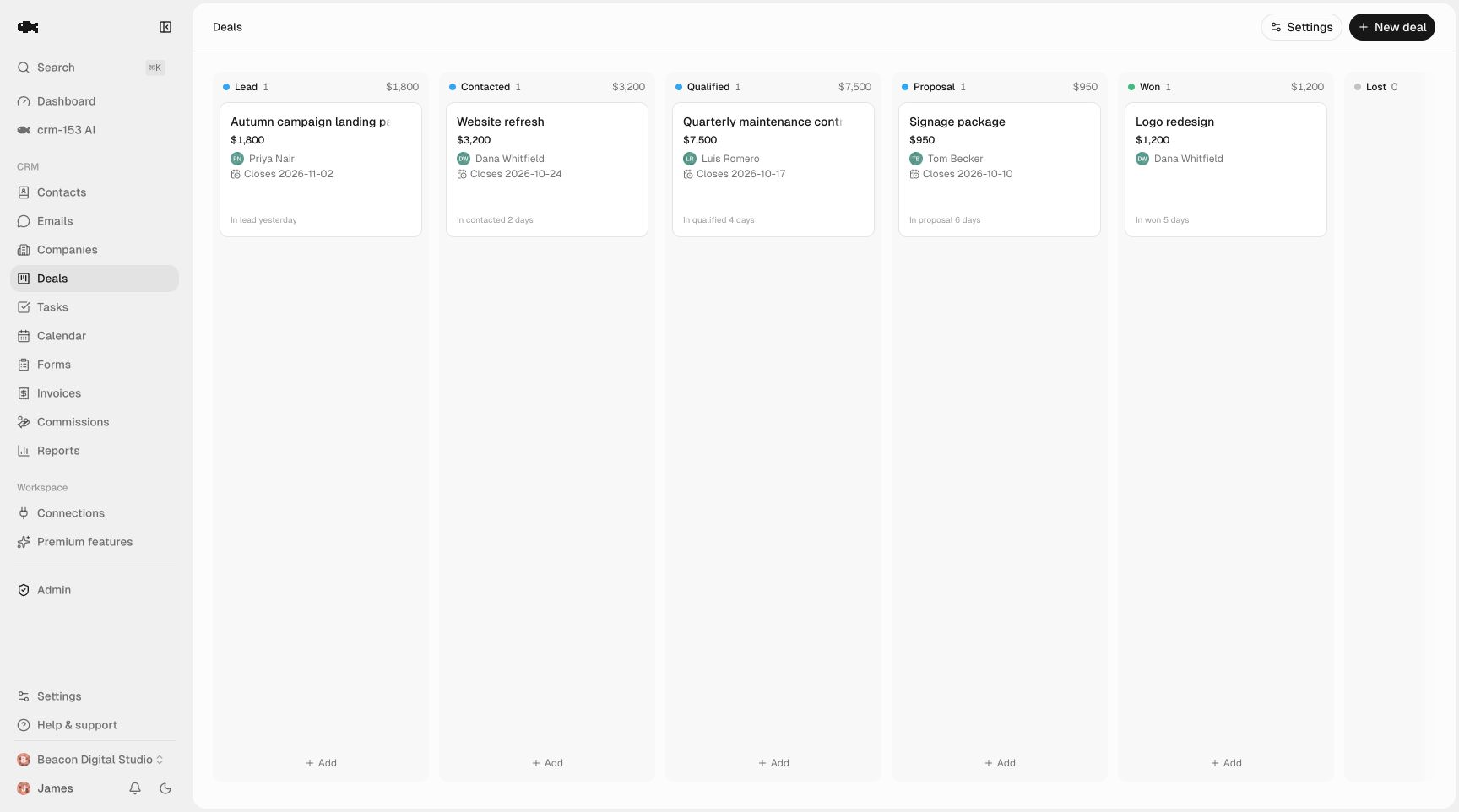
The value of a kanban board here is that you can see, at a glance, how many events are confirmed for next month and how much money is sitting in "Quote sent" waiting on a reply. crm-153's sales pipeline gives you unlimited pipelines with custom stages and a per-column dollar total, so your catering board and your repeat-client board live side by side.
If you've never mapped stages before, how to define sales pipeline stages that match how you actually sell walks through drawing boundaries that fit your real process.
Capture every inquiry the moment it lands
The hardest leak to plug is the one that happens in the first hour. A catering request sits in an Instagram DM, you mean to answer after the lunch rush, and by evening it's buried under thirty other messages.
The fix is a dead-simple habit: every inquiry becomes a contact and a deal card before you do anything else. Thirty seconds, even mid-shift. Capture:
- Name and best contact method (and where the lead came from — DM, web form, referral, walk-up)
- Event date and headcount
- What they're asking for
- A follow-up task with a due date
With contact management you get unlimited contacts with tags and search, so you can tag someone catering, wedding, corporate, or food-festival and pull up a whole segment later. Tagging by lead source also tells you over time whether Instagram or word-of-mouth actually fills your calendar.
Reminders are the whole game
Catering buyers are comparison-shopping. The caterer who replies first and follows up once usually wins — not because the food is better, but because they were reachable and organized. A quote sent and never followed up on is a lost booking.
Set a follow-up task on every open inquiry:
- Quote sent, no reply → follow up in 2 days, then again in 5
- Deposit not received → nudge a week before the event
- Event completed → thank-you message within 48 hours, then a re-book nudge 60–90 days out for anyone who could become a regular
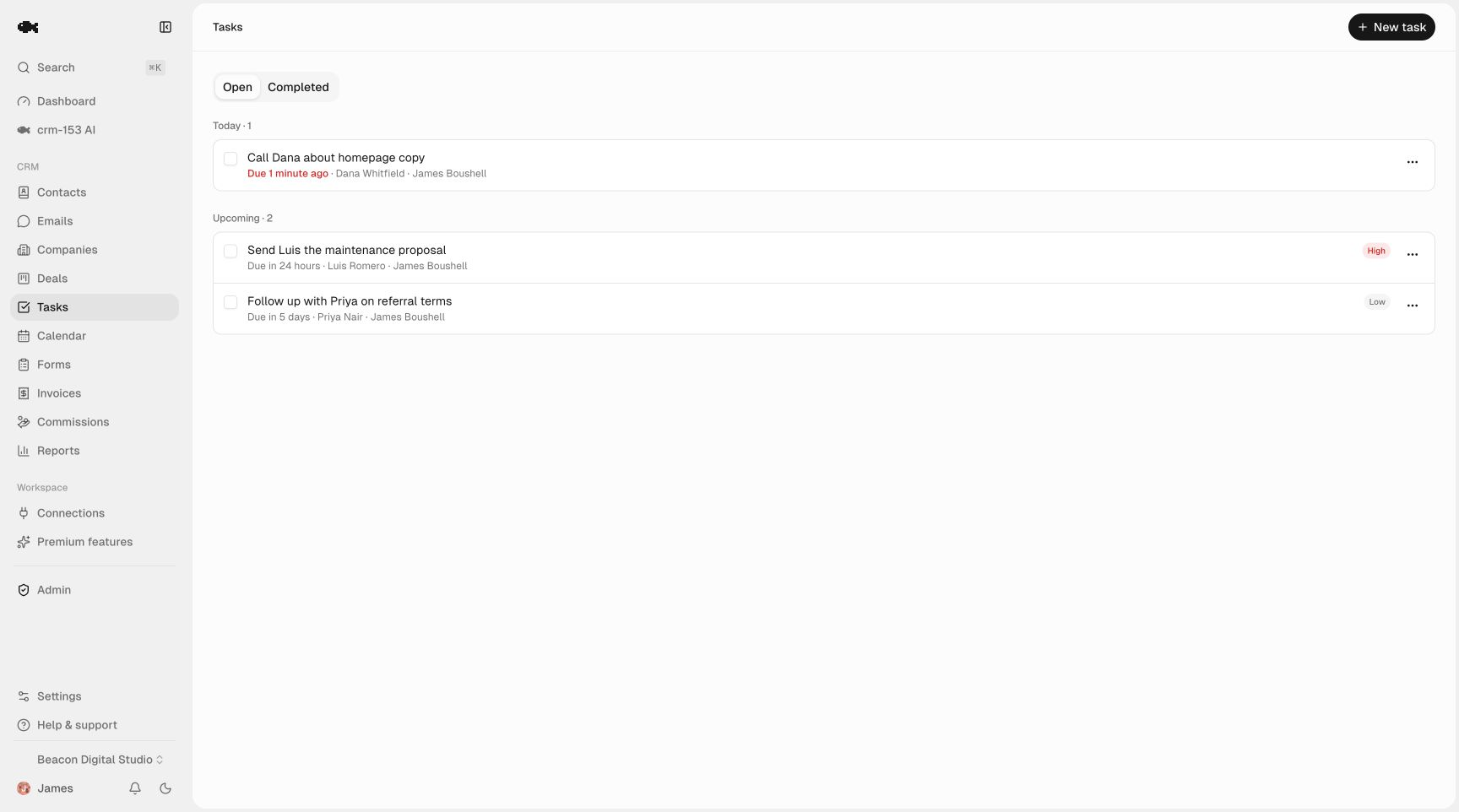
crm-153's tasks and reminders handle this with due dates and automatic in-app and email reminders, grouped into Today, Overdue, and Upcoming so you open one screen and know exactly who needs a reply today.
For the follow-up discipline itself, a lead follow-up system that doesn't depend on memory and follow-up email templates that actually get replies are worth a read.
Turn one-time events into repeat customers
The office that booked you for a holiday party is your easiest next sale — if you remember them. This is where small operations leave the most money on the table.
Keep the history on the record. With the activity timeline you log calls, emails, meetings, and notes in one click, and the whole team sees the same thread. When the law firm calls back next quarter, you can see what you served last time, what they paid, and that they asked for extra vegetarian options — before you even pick up.
That shared history is also how you run loyalty deliberately instead of hoping people remember you. For a deeper playbook on reorder timing and lifetime value, see how to use a CRM to manage repeat customers.
Working the truck (or the floor) as a team
If you've got a co-owner, a partner handling catering sales, and staff who take phone inquiries, everyone needs to see the same board — otherwise two people quote the same wedding, or nobody does.
crm-153 offers unlimited team seats, so the whole crew works from one shared workspace with owner-based filters. No per-seat fee means you're not rationing access to the person who happens to answer the phone most. If sharing a board across a small team is new to you, how to share a sales pipeline with your team for free covers owners and assignment.
Why free actually matters for a food business
Margins in food are thin, and a CRM is overhead you shouldn't be paying for. Plenty of "free" CRMs cap your contacts, limit seats, or lock export behind a paid plan — worth checking any tool's current pricing page before you commit.
crm-153 is genuinely free: unlimited contacts, unlimited pipelines, unlimited users, and full CSV import and export always available, so your customer list stays yours. The only money crm-153 ever touches is a small fee on optional online invoice payments — the CRM itself is $0, which you can confirm on the pricing page. If you're skeptical about the "free" claim, how can a CRM be free? explains the model honestly.
A 30-minute starting point
- Import your existing contacts and past catering clients from your phone or a spreadsheet via CSV import.
- Build your two pipelines — catering/events and repeat clients — with the stages above.
- Drop every open inquiry onto the catering board with a next-step task.
- Tag past one-time events you'd like to turn into regulars, and set a re-book reminder on each.
You can poke around a real workspace first in the live demo. When you're ready, start free — no credit card, no trial clock — and get your next booking off a sticky note and onto a board that will remind you to follow up.